At the urban renewal site in the old town, a three-stage demolition excavator with an extended arm has been deployed for old building demolition. It replaces the traditional scaffolding and manual breaking method, boosting safety and controllability for high-rise demolition and becoming core equipment for urban renewal.
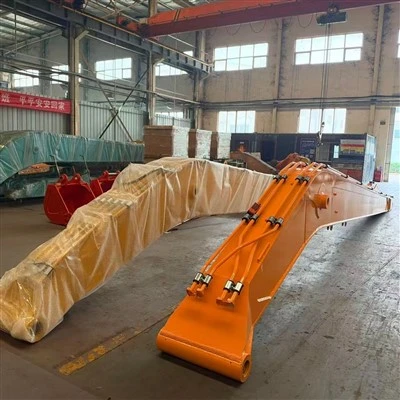
Conventional high-rise demolition usually requires workers to build platforms on buildings for crushing, which carries high risks of falling debris and sudden structural collapse, alongside long construction cycles. This unit reaches a maximum working height of 28 meters. Operators control the breaker remotely from the ground cab to dismantle walls and beams layer by layer from top down, keeping personnel out of hazardous zones. Its arm features optimized lightweight construction and improved impact resistance to suit frequent breaker impacts, plus pipeline guards to prevent stone damage.
Old town sites feature dense buildings close to residential areas, with strict limits on dust and flying gravel. The extended arm enables fixed-point demolition with precise breaking positioning, paired with fog cannons for dust suppression. It controls demolition sequences accurately to take buildings apart gradually and avoid damaging nearby pipelines and roads from uncontrolled collapse.
This demolition arm is a specialized attachment, engineered differently from dredging or foundation pit arms. Cylinder layout, hinge stress and counterweight systems require custom design; generic arms may cause instability or bending failures. This project uses a three-stage version matched for 30-ton excavators, balancing working height and overall stability.
As urban renewal expands across China, old building and factory renovation projects grow, lifting market demand for demolition arms. Many overseas urban renewal projects now source domestically built demolition units with this extended arm. Local manufacturers stand out with competitive structural engineering, faster lead times and reliable after-sales packages.