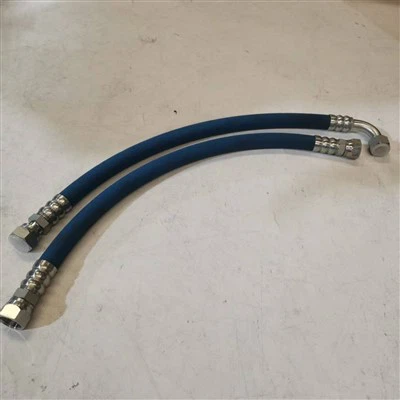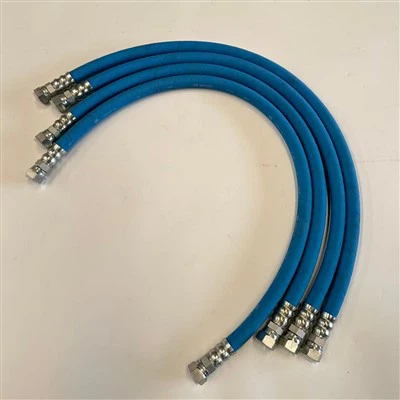
Hydraulic hoses are responsible for transporting high-pressure hydraulic fluid in hydraulic systems. Their material selection directly affects pressure resistance, durability, environmental adaptability, and overall operational safety. Under different working conditions and media conditions, a scientifically sound material selection can ensure efficient system operation while extending pipeline lifespan and reducing maintenance costs.
Hydraulic hoses generally consist of three parts: an inner rubber layer, a reinforcing layer, and an outer protective layer. The materials of each layer must work together to meet comprehensive performance requirements such as oil resistance, pressure resistance, heat resistance, aging resistance, and wear resistance. The inner rubber layer often uses special synthetic rubbers such as nitrile rubber (NBR), hydrogenated nitrile rubber (HNBR), or fluororubber (FKM). Among these, NBR has excellent resistance to mineral oils and a moderate cost, making it suitable for conventional hydraulic oil environments; HNBR has better aging resistance and heat resistance in high-temperature and sulfur-containing oils; and FKM can withstand various chemical media and extreme temperatures, often used in special or corrosive conditions.
The reinforcing layer is crucial in determining the pressure-bearing capacity of the tubing, and commonly takes the form of high-strength steel wire braiding or winding. Braided layers offer good flexibility and moderate pressure-bearing capacity, suitable for small to medium flow and pressure circuits; wound layers, with higher layer counts and density, enhance pressure resistance and can meet the needs of ultra-high pressure hydraulic systems. The braiding or winding angle and density need to be optimized based on the working pressure and pulse characteristics to balance strength and elasticity.
The outer sheath material must resist environmental corrosion and mechanical damage, commonly using neoprene (CR), polyurethane (PU), or thermoplastic elastomers (TPE). CR offers a balanced combination of weather resistance, ozone resistance, and abrasion resistance, widely used in outdoor and engineering equipment; PU excels in abrasion resistance, suitable for high-friction or gravel environments; TPE is lightweight and recyclable, suitable for environmentally and weight-sensitive applications.
During material selection, the operating temperature range, fluid type, pulse frequency, and potential chemical exposure must also be considered. For example, in cold regions, rubber formulations with good low-temperature elasticity should be selected, while in high-temperature conditions, the thermal stability of the hose and reinforcing layer must be ensured. At the same time, compatibility testing of different materials is crucial to avoid performance degradation caused by swelling or degradation reactions between the hose and the hydraulic fluid.
Scientific selection of hydraulic hose materials not only meets system pressure and media requirements but also maintains stable performance in complex environments and long-term cycles, thus providing a reliable guarantee for the efficient and safe operation of the hydraulic system.